Trade finance compliance for banks – every release evidenced.
Letters of credit, guarantees, collections and export finance are among a bank’s riskiest business: many parties, goods, vessels and countries, little time. TFI TradeCore runs every transaction through sanctions, export control and TBML controls, blocks release while a finding is open and documents every decision so that supervisors and internal audit can follow it.
What trade finance controls are measured against
- Directive (EU) 2015/849 as amended · AMLR from 10 Jul 2027 · national AML law
Due diligence
Customer due diligence, enhanced review for high risk and a documented risk assessment – soon uniform across the EU under Reg. (EU) 2024/1624.
- Wolfsberg · ICC · BAFT
Trade finance standards
The Trade Finance Principles set out the expected controls per product – from letters of credit to guarantees.
- FATF and Egmont Group · 2021
TBML indicators
Risk indicators for trade-based money laundering: prices, quantities, goods, routes and payment flows.
- EU · UN · UK · US
Sanctions
Parties, ownership and control, goods, vessels and ports – with a documented decision on every hit.
- Reg. (EU) 2022/2554 (DORA) · since 17 Jan 2025
ICT third-party providers
Contracts, audit rights and exit strategy for the software you use – running it in your environment makes it easier to manage.
- UCP 600 · URDG 758 · URC 522
ICC rules
Document examination, guarantee demands and collections under the rules your transactions agree.
Three cases from daily business
- 01
A letter of credit with an unusual price
The unit price is far above the market benchmark, and payment runs through a third party. TradeCore raises both typologies as findings, holds release and routes the decision to the second-line review.
- 02
A hit on a vessel
The named vessel is on a sanctions list by its IMO number. The hit appears with evidence; the transaction stays blocked until a four-eyes decision.
- 03
Suspicion of money laundering
A finding gives rise to suspicion. The report is prepared in the money laundering reporting officer’s restricted area, in goAML format; the business and the customer only see a neutral hold reason – protection against tipping-off.
From instruction to release
- 01
Capture
- Letter of credit, guarantee, collection or financing with every party
- Goods with HS code, ports by UN/LOCODE, vessels by IMO number
- Documents with version and SHA-256 checksum
- 02
Controls
- Sanctions screening with evidence per hit
- Export control and dual use by HS code and destination
- TBML typologies, price plausibility and party network
- 03
Release
- Release gate while any finding is open
- Maker-checker and multi-level approval by risk class
- Changes to a transaction force a new review
- 04
Tenor and audit
- Amendments, demands and deadlines
- Second-line, quality and thematic reviews
- Tamper-evident audit log
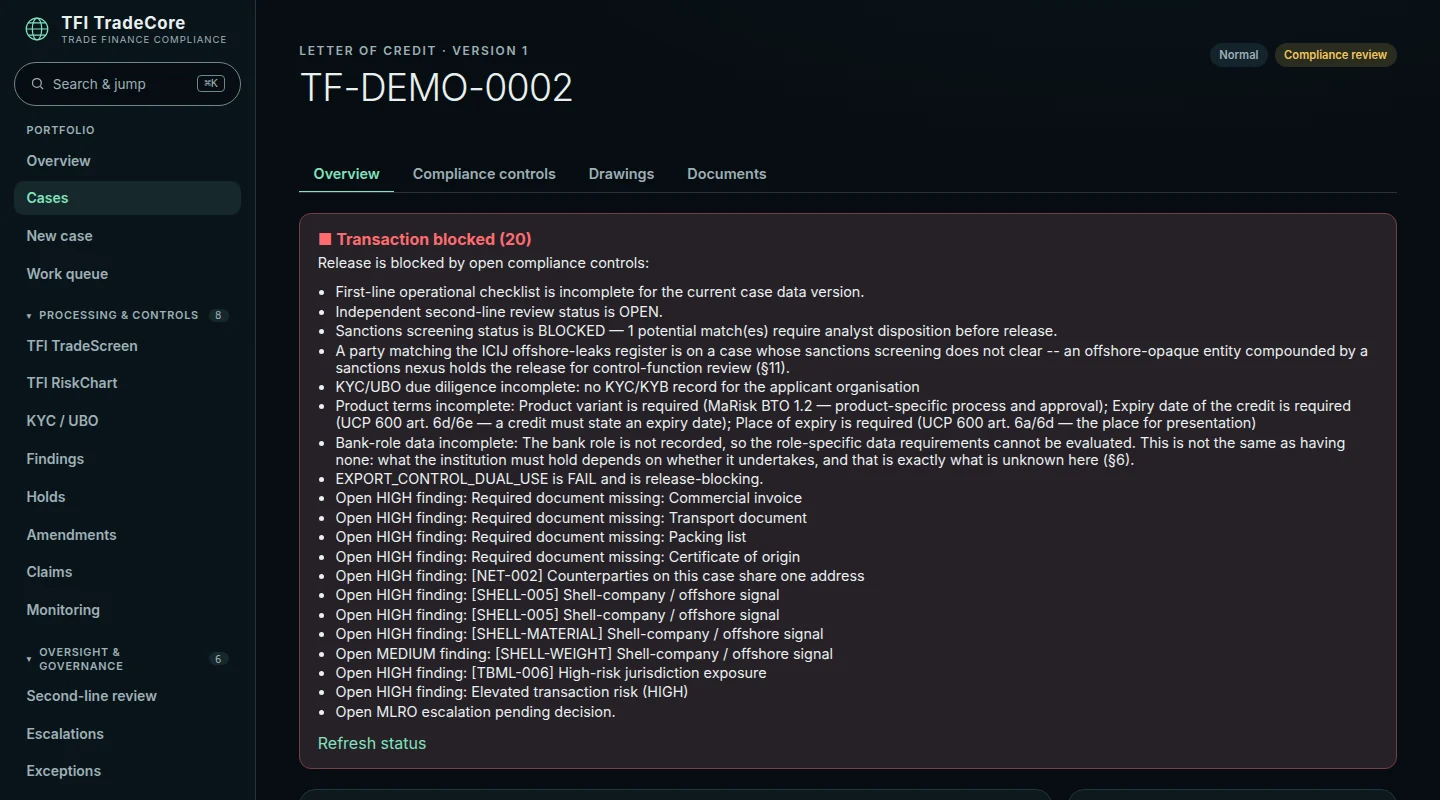
The release gate in practice
While controls are open, TradeCore shows every reason individually – from an undecided sanctions hit to a missing document. Screenshot with synthetic demo data.
What TFI provides for banks
- TFI TradeCore
Case handling and control layer for letters of credit, guarantees, collections and financing – with release gate, segregation of duties, MLRO area and audit log.
- TFI RiskChart
Country risk from official sources for the risk assessment and the individual case – FATF, EU high-risk countries, sanctions regimes, export control.
- TFI Newsletter
A daily overview of sanctions packages, supervisory notices and enforcement – evidenced with primary sources.
- TFI TradeScreen
Screening of parties, offshore structures, goods and corridors in TradeCore – explainable, reproducible, decided under the four-eyes principle.
- Advisory and audit
TBML risk assessment, review guides per product, AMLR gap analysis and training for operations and compliance.
Fits your IT and DORA governance.
- Deployment
Runs in your environment
On premises or in your cloud, as containers with PostgreSQL. Your data never leaves your institution.
- Access
Sign-in and permissions
Connection to your identity provider via OpenID Connect, such as Microsoft Entra ID with MFA; roles along the three lines of defence, strict tenant separation.
- DORA
Documents for the outsourcing review
Software bill of materials (SBOM), role and permission matrix, security and operations concept, a traceable change history of the rules.
Pilot for one product line
TFI TradeCore is pre-production: technically complete and backed by more than 3,600 automated tests (as of September 2026), but not yet released for production use with real customer data. That is why we start with a clearly scoped pilot project in a test or shadow environment. We start with one product line – import letters of credit, for example.
- TFI TradeCore in your test or pilot environment
- Official sanctions lists fetched in your environment, plus your identity provider
- Your roles, approval levels and escalation paths
- Evaluation against agreed success criteria and a decision on roll-out
Questions from banks
No legal advice. Core banking, SWIFT and PEP screening connections are customer-provided (interface ready, not live); TradeCore does not book or send by itself. TFI TradeCore prepares decisions, holds and evidences – your responsible people decide and report.
Does TradeCore replace our screening system?
Usually it complements it. TradeCore screens against official lists straight from the source, with explainable matching and in the context of the transaction – a hit holds release and payout. TradeCore does not supply its own list database, PEP or adverse media feeds; licensed data connects through a normalised format. PEP screening is a customer-provided connection (interface ready, not live); until then a placeholder holds the release.
How does TradeCore help with the AMLR?
The controls are risk-based, documented and reproducible: every review records rule version, data version and decision-maker. That is the foundation supervisors and the AMLA expect. Our advisory team runs the AMLR gap analysis.
Does TradeCore run in our environment?
Yes. TradeCore runs as containers with PostgreSQL – on premises or in your cloud. Sign-in through your identity provider, tenants strictly separated.
Is TradeCore already in production use?
No. TradeCore is technically complete and extensively tested, but not yet approved for production decisions on real customer data. That is exactly what the pilot is for.